Which Power Connector Your Card Actually Needs
Wattage is half of PSU compatibility. This is the other half.
Quick Summary · TL;DR
Check the connector on your exact board model, not the GPU name — board partners differ. Then check that your supply has that many native cables, and for a 16-pin card, that the supply’s 12V-2x6 cable is rated at or above the card’s board power.
The same GPU, different connectors
Connector count is a board-partner decision, like size. From our own clearance dataset:
| Card | Board power | Power connector |
|---|---|---|
| PowerColor Reaper Radeon RX 9070 XT | 304W | 2 × 8-pin |
| ASUS TUF Gaming Radeon RX 9070 XT | 304W | 3 × 8-pin |
| MSI RTX 3070 Ti VENTUS 3X OC | 290W | 2 × 8-pin |
| MSI RTX 3070 Ti SUPRIM X | 310W | 3 × 8-pin |
| NVIDIA RTX 5080 Founders Edition | 360W | 1 × 16-pin (12V-2x6) |
Two cards with identical board power can want a different number of cables. Always read the specification for the exact model you are buying.
The three connectors you will meet
6-pin and 8-pin PCIe
The long-standing standard. An 8-pin is usually supplied as a 6+2 that splits, so one cable can serve either. The important word is native: a cable running from its own port on the supply to one connector on the card. The number of connector heads is not the number of independent cable runs. Follow the GPU and PSU manufacturers’ instructions for whether a daisy-chained cable is permitted; this guide does not set a universal wattage threshold.
12VHPWR (16-pin)
Introduced with ATX 3.0 to carry up to 600W down one cable, with four small sense pins telling the card how much the supply can deliver. Early implementations gained a reputation for connector damage when the plug was not fully seated.
12V-2x6
The revised version of the same 16-pin connector. The terminals and sense pins were reworked so that the power and sense contacts engage in a revised sequence intended to reduce risks from incomplete insertion. This does not make a loose or incorrectly routed connection safe. It is physically compatible with 12VHPWR; if you are buying new, a supply advertising ATX 3.1 and 12V-2x6 is the one to choose.
What to check on the supply
- Native cable count. If your card wants three 8-pins, the supply needs three separate PCIe ports and three cables — not two cables with a split head.
- 12V-2x6 cable rating. Supplies publish a wattage for that cable, and it is not always 600W. A card whose board power exceeds the cable rating must not use it, even though the plug fits.
- No mixing of modular cables between units. Pinouts differ between manufacturers and sometimes between series from the same manufacturer. This is the single most expensive mistake in this article.
- Adapters are a fallback. The bundled 16-pin-to-8-pin adapters exist so a new card works with an older supply. They add connection points and stiffness in a place where both matter.
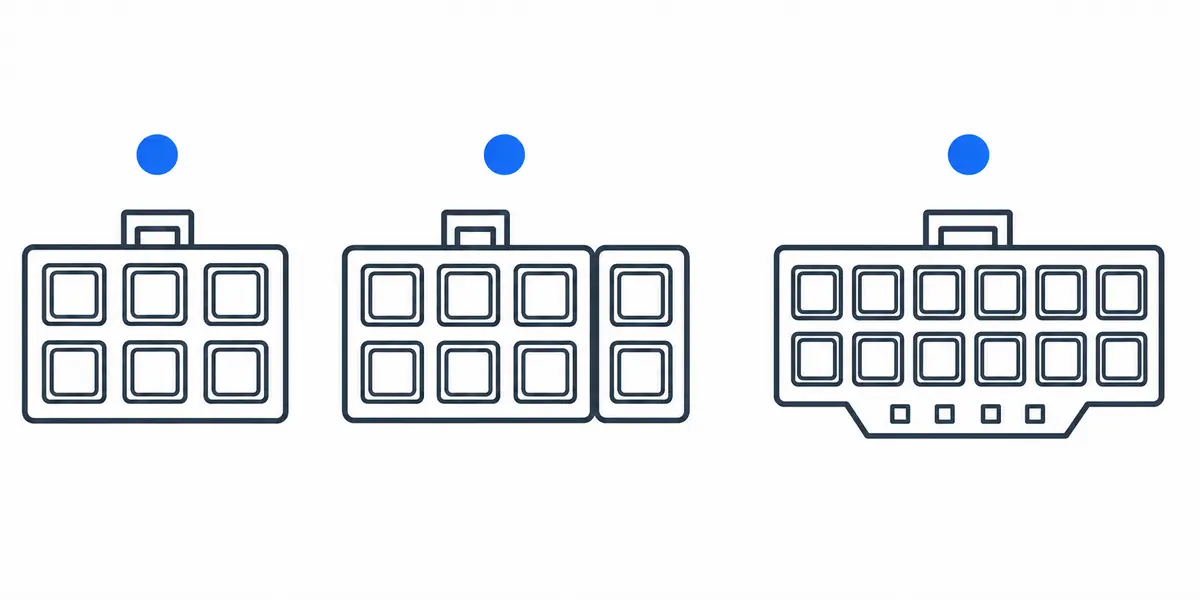
Seating a 16-pin plug
Push until the latch clicks, then look at the plug from the side: no gap should be visible between the plug housing and the socket. Route the cable so that any bend starts at least 35mm from the connector — the bend radius is the reason many compact builds need a right-angle adapter or a case with a dedicated cable channel. If your case cannot give the cable that room, that is a case-fit problem, and our clearance guide covers how to measure for it.
Size and connector together
Every per-card PSU page lists the connector alongside the wattage, and the PSU calculator sizes the supply for your full parts list.
Sources & verification
- NVIDIA GeForce RTX 50 Series specifications
- AMD Radeon desktop graphics specifications
- SpecsCalc calculation methodology and limitations
Connector data is per board-partner model as recorded in our dataset. Confirm against the product page for your exact SKU and against your power supply’s cable specification. Last reviewed September 12, 2026.