The Three Measurements That Decide Whether a GPU Fits
Length, height, thickness — and why “it is a 2-slot card” tells you almost nothing.
Quick Summary · TL;DR
Fit is decided by three published millimetre figures on the card and three on the case configuration you are actually using. Slot count is a mounting-bracket description, not a thickness, and converting slots to millimetres is the single most common way people end up with a card that will not close the side panel.
Two cards, one GPU name, 52mm apart
The same GPU ships in board-partner designs that are not remotely the same size. These are figures from our own clearance dataset:
| Card | Length | Height | Thickness |
|---|---|---|---|
| PowerColor Reaper Radeon RX 9070 XT | 288mm | 111mm | 41mm |
| Sapphire Pulse Radeon RX 9070 XT | 321mm | 133mm | 60mm |
| PowerColor Red Devil Radeon RX 9070 XT | 340mm | 134mm | 64mm |
| MSI RTX 3070 Ti VENTUS 3X OC | 305mm | 120mm | 57mm |
| MSI RTX 3070 Ti SUPRIM X | 335mm | 140mm | 61mm |
Dimensions are carried in our dataset as board-partner figures pending manufacturer-page re-confirmation; verify your exact SKU before buying.
The Reaper and the Red Devil are both “an RX 9070 XT”. One is 52mm shorter and 23mm thinner than the other. In a compact case that is not a detail, it is the whole answer.
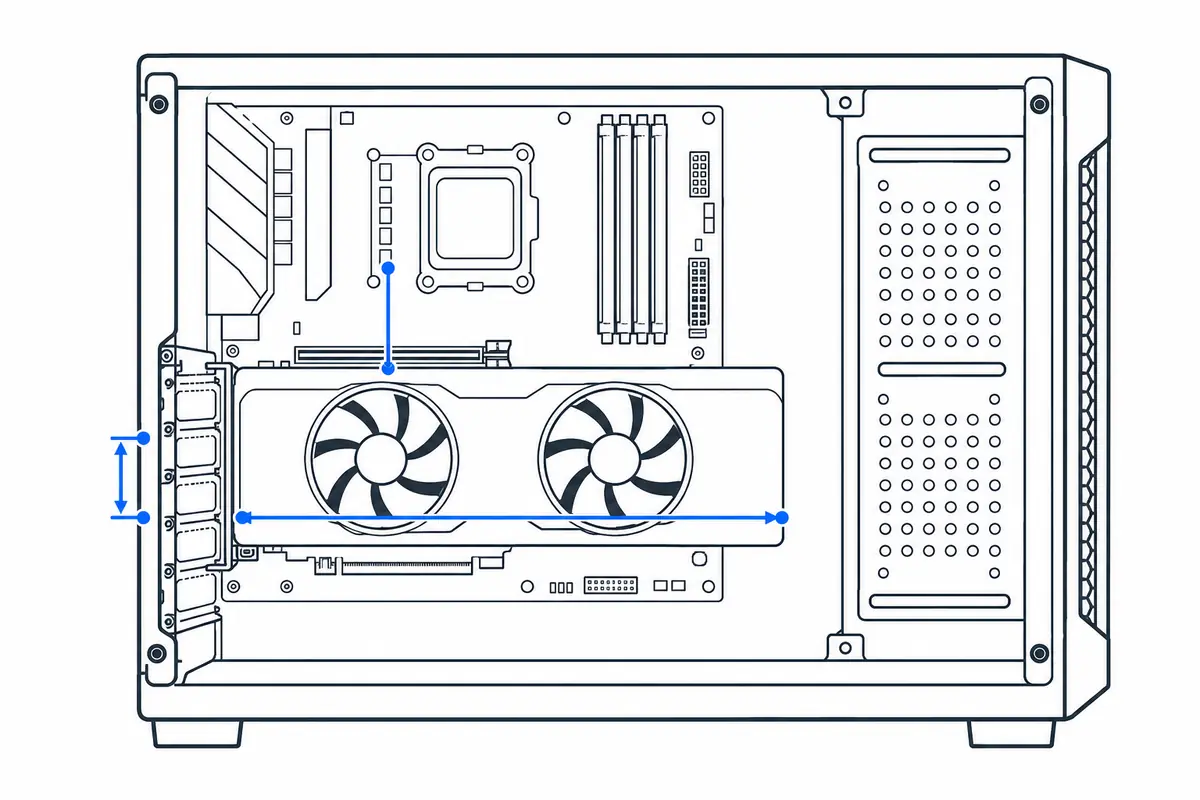
The three card measurements
Length
The easy one, and the one everybody checks. The trap is where the manufacturer measures from: some quote the PCB, some quote the shroud, and the power connector may stick out past both. Cooler Master, for instance, states that the NR200P V2 length and height allowances include the power connector — which means a card measured without its connector can still foul.
Height
Measured from the slot bracket upward. This is what stops a thick triple-fan card in a case with a side-panel fan bracket or a glass panel. It is also the figure most often missing from spec sheets, and a missing figure is not a pass — our checker returns unknown rather than guessing.
Thickness
The dimension that actually ends builds. Published in millimetres by the case maker, and increasingly by the card maker too.
Why slot count is not thickness
A PCI Express slot pitch is 20.32mm, so “2 slots” gets converted to 40.6mm by anyone in a hurry. The conversion has no basis: a “2-slot” cooler can measure 41mm or 45mm, and the 4mm difference is exactly the margin you were relying on. Our engine never performs that conversion; a card without a published millimetre thickness is reported as unknown, and we would rather show you an unknown than a confident wrong answer.
The case side is not one number either
Case clearance depends on the configuration you build in. Real published examples from the dataset behind our checker:
- Cooler Master NR200P V2 — 357mm length if the card is mounted so it exceeds the front bracket, but then only 73mm of thickness. Keep it within the bracket and you gain 7mm of thickness and lose 23mm of length.
- SSUPD Meshroom S V2 — the 3-slot tray allows 61mm thickness with 74mm of CPU cooler height; the 4-slot tray allows 76mm thickness but drops cooler height to 54mm. The optional feet add 21mm of GPU length.
- Fractal Terra — a movable spine trades the two directly: position 1 gives a 77mm cooler and a 33mm card; position 7 gives a 62mm card and a 48mm cooler. Every step is 5mm one way and 5mm the other.
- Fractal Mood — 145mm GPU height excluding cables, 158mm including them. If your card takes a 16-pin cable out of the top edge, the number you need is 158mm.
- Lian Li A4-H2O — 322mm length and a 3-slot bracket published, but no millimetre height or thickness limit at all. Both stay unknown in our data.
How to measure what you already own
- Length: from the outer face of the slot bracket to the far end of the shroud, then add whatever the power cable needs to bend — a right-angle adapter or a 35mm bend allowance is realistic for a top-mounted connector.
- Height: from the top edge of the slot bracket to the top of the shroud or backplate, not from the PCB.
- Thickness: lay the card flat and measure from the backplate face to the highest point of the cooler, including any heat-pipe hump.
- Write all three down and compare against the specific case configuration you will build in, not the case’s best-case headline figure.
Check your exact pair
The SFF GPU clearance checker takes exact millimetres and returns a per-configuration verdict, including the cases where a required limit is simply not published.
Sources & verification
- Fractal Design Terra specifications
- Cooler Master NR200P series
- SpecsCalc calculation methodology and limitations
Case limits are the manufacturers’ published figures for the configuration named. Card dimensions are board-partner figures; confirm the exact SKU and the current case revision. Last reviewed September 12, 2026.