SFF GPU Clearance Checker
Will that graphics card actually fit your small-form-factor case? Checks length, thickness, height and cable bend across every spine position.
Exact card thickness in mm (measure the card, do not convert from slot count).
Radiators and fans may reduce usable GPU clearance. This checker does not model radiator interference yet — use the manufacturer’s configuration table to confirm a water-cooled build.
Quick Summary · TL;DR
SFF fitment is three-dimensional: length, thickness (slots) and height all have to clear at once, and a rigid power connector adds bend-radius height on top. This checker iterates every spine position of the case and only passes a configuration where all axes fit — then tells you the matching CPU-cooler limit.
Why length alone isn’t enough
Most fitment guides only list a maximum GPU length, but in sandwich-layout cases the real limit is usually thickness. A 4-slot card may clear on length yet collide with the side panel, and a flush 12VHPWR plug can add roughly 18mm of bend-radius height that pushes a card over the edge. This tool models all of that, including the non-linear curvature penalty in cases like the Fractal Terra.
Always verify: case limits are manufacturer-stated, but graphics-card dimensions differ between AIB models. Confirm your exact card’s length, height and slot width before purchasing.
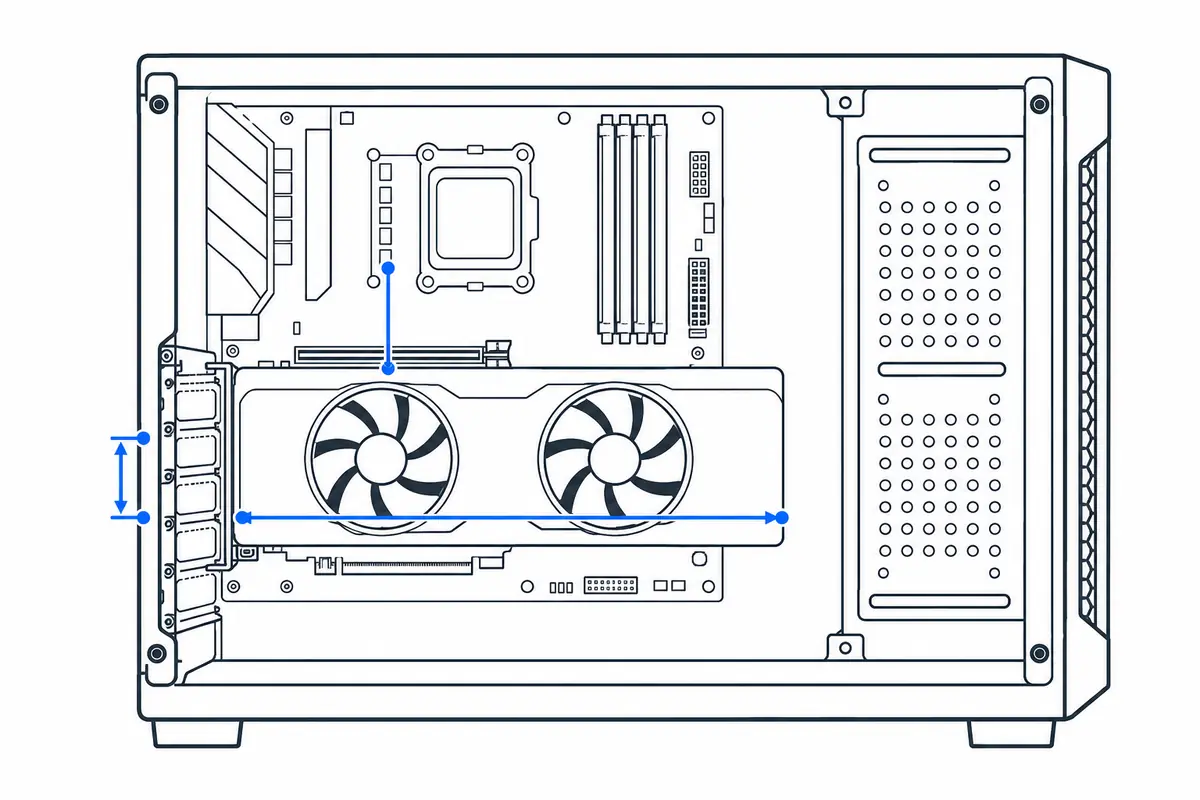
How to measure GPU clearance in an SFF case
Small-form-factor fit depends on three dimensions plus the space taken by radiators, fans, riser layout and power cables. A card can pass the published length limit and still fail on thickness or connector clearance.
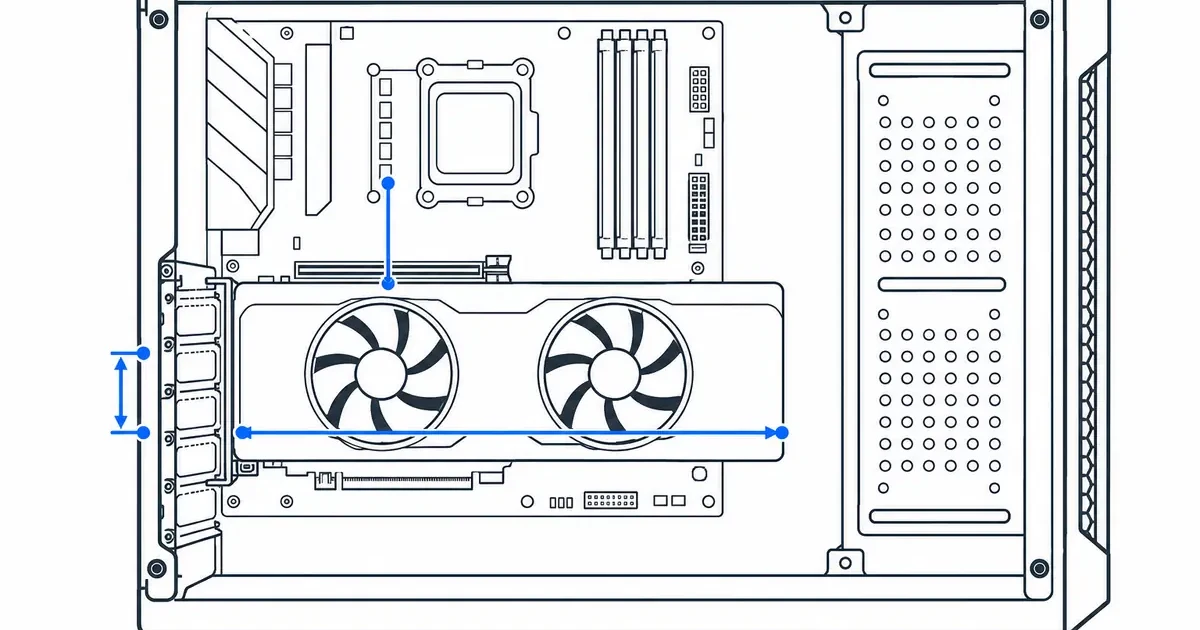
Step by step
- Select the exact graphics card model or enter its manufacturer dimensions, not only the GPU chip name.
- Select the case layout and note whether front fans, a radiator, drive cage or vertical mount changes the available space.
- Compare length, card height and slot thickness; all three must pass.
- Reserve connector and cable-bend clearance, especially beside the side panel on high-power cards.
How to read the result
Pass means the listed outer dimensions fit inside the stored case limits. Borderline means tolerances are small enough that cable routing or optional hardware could change the answer. Unknown dimensions must be measured manually.
Common mistakes to avoid
- Using reference-card dimensions for a larger factory-overclocked partner card.
- Counting bracket slots while ignoring a cooler that extends beyond the final slot.
- Forgetting that a front radiator and fans reduce usable GPU length.
- Pressing a power cable sharply against the side panel or bending it immediately at the connector.
Verify before you buy or change settings
Open the case compatibility list and the exact graphics-card dimensional drawing. Check forum build photos only as supporting evidence because revisions can change. Leave practical tolerance for manufacturing variation, riser movement and airflow; a theoretical zero-millimetre fit is not a comfortable build.
Calculator logic and this guide were reviewed August 27, 2026. See the methodology and limitations.
Frequently asked questions
Why does my GPU need extra clearance for the power cable?
Because a rigid 12VHPWR or 8-pin plug needs bend-radius room above the card; a flush 12VHPWR connector can add roughly 18mm to the effective height, which matters in a tight sandwich-layout case.
What is the most common reason a GPU won't fit an SFF case?
Thickness, not length. Many builders check the length limit but miss that a 3.5 or 4-slot cooler is too thick for the case's spine position, causing a collision against the side panel.
Are these clearance numbers exact for every card?
They use manufacturer-stated case limits, but graphics-card dimensions vary by AIB model, so always confirm the exact length, height and slot width of your specific card before buying.
Building small? Size the power supply with the PSU Calculator (SFX units) and browse all tools on the tools page.