PSU Wattage Calculator
Pick your parts and get the recommended power supply size, with an explicit sizing buffer and estimated load.
Quick Summary · TL;DR
Recommended PSU = (CPU peak W + GPU peak W + ~80-120W system) × 1.25, rounded up to a standard size. For most single-GPU gaming builds in 2026 that lands between 550W and 850W. Always choose an 80+ Gold, ATX 3.0/3.1 unit.
How the calculation works
The estimator sums the realistic peak power of each component, then multiplies by 1.25. CPUs and GPUs dominate the total; storage, RAM, fans and peripherals add only a small fixed amount. The buffer matters because a power supply is happiest at 50-80% load and because modern graphics cards spike far above their average draw for milliseconds at a time.
| Component | Typical peak draw |
|---|---|
| Mid-range GPU | 150-260W |
| High-end GPU (RTX 5080/5090) | 360-575W |
| Gaming CPU | 76-253W |
| Board + RAM + drives + fans | ~80-120W |

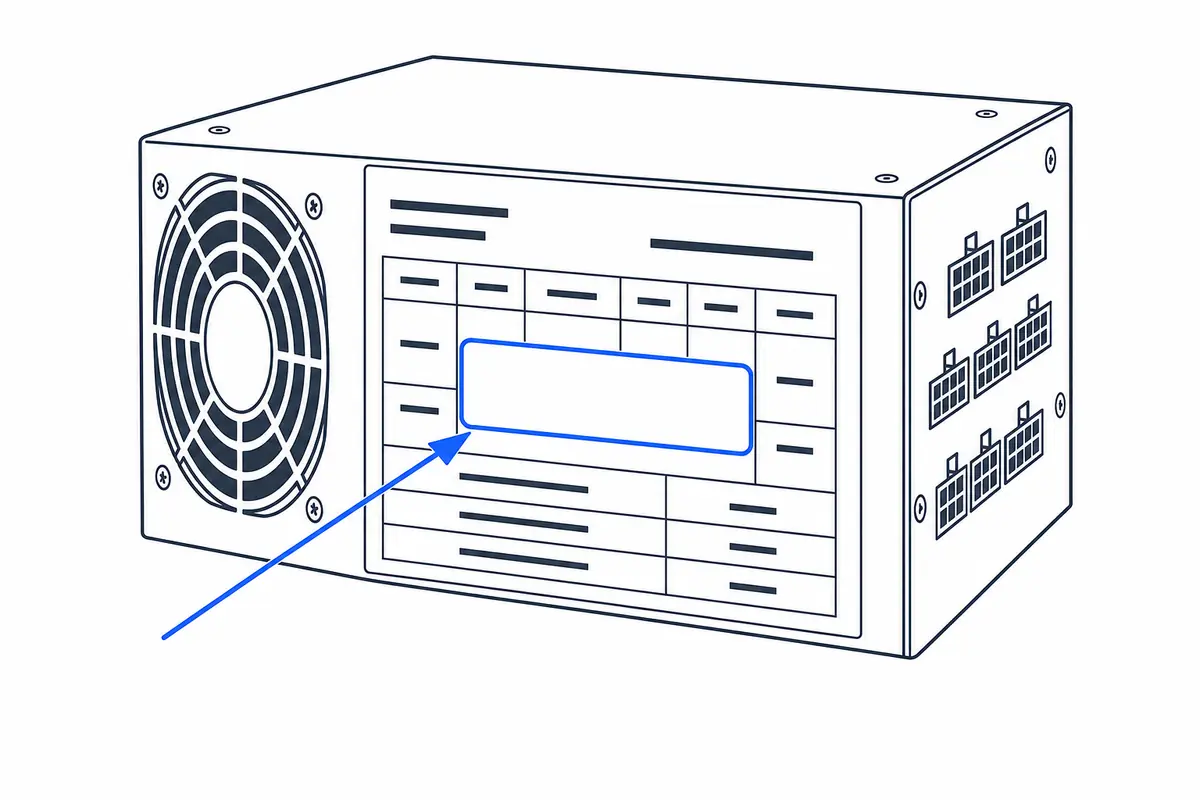
How to size a power supply
A PSU should cover sustained component draw, short GPU transients and future ageing without spending most of its life near the limit. The calculator adds headroom to an estimated system load and rounds to a commonly available wattage class.
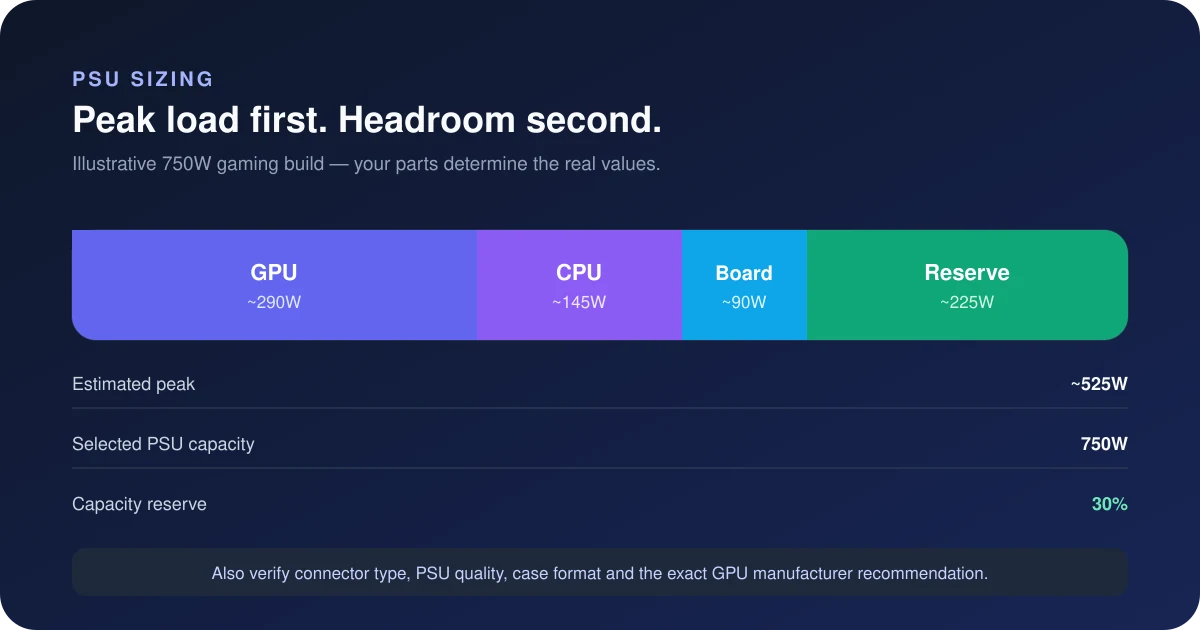
Step by step
- Choose the exact CPU and GPU class because those parts dominate peak system demand.
- Add drives, fans, pumps, USB devices and overclocking only when they are genuinely part of the build.
- Read both estimated load and recommended capacity; the difference is operating and transient headroom.
- Select a quality unit with the correct form factor and native connectors, not wattage alone.
How to read the result
The recommendation is a capacity class, not a claim that the PC will always draw that amount. Typical gaming draw is usually lower than the calculated worst case. A larger number also does not make a poor-quality unit safer.
Common mistakes to avoid
- Adding the advertised maximum of every component and then doubling it, which can oversize the PSU unnecessarily.
- Using GPU board power alone while ignoring the CPU, pump, drives, fans and transient spikes.
- Adapting multiple legacy 8-pin cables when the GPU and PSU support a native 12V-2x6 cable.
- Assuming an efficiency badge measures electrical quality, protection tuning or noise.
Verify before you buy or change settings
Check the GPU maker’s recommended capacity and connector count, then confirm the PSU manufacturer lists the required native cables. For compact builds, verify SFX, SFX-L or ATX dimensions. Never reuse modular cables from a different PSU unless the manufacturer explicitly confirms pinout compatibility.
Calculator logic and this guide were reviewed September 12, 2026. See the methodology and limitations.
Frequently asked questions
What size PSU do I need for my PC?
Add up the CPU and GPU peak power, plus about 80-120W for the rest of the system, then add a 25% buffer. This calculator does that for you and rounds up to the nearest standard PSU size.
Why add a 25% buffer instead of buying the exact wattage?
Modern GPUs produce millisecond transient spikes that can briefly double their rated draw, and PSUs are most efficient at 50-80% load. A 25% buffer covers both and extends the unit's lifespan.
Do I need an ATX 3.0 or 3.1 power supply?
If you run a modern NVIDIA RTX 40/50-series card, yes; ATX 3.x units include the native 12VHPWR connector and are rated to ride out transient spikes without shutting down.
Building from scratch? Start with a balanced parts list using the Auto PC Builder, or check pairing with the Bottleneck Estimator. Looking up a specific card? See what PSU each GPU needs.