Frame Time Explains Diminishing Returns
The same arithmetic that makes 60 to 120 FPS transformative makes 240 to 360 nearly invisible.
Quick Summary · TL;DR
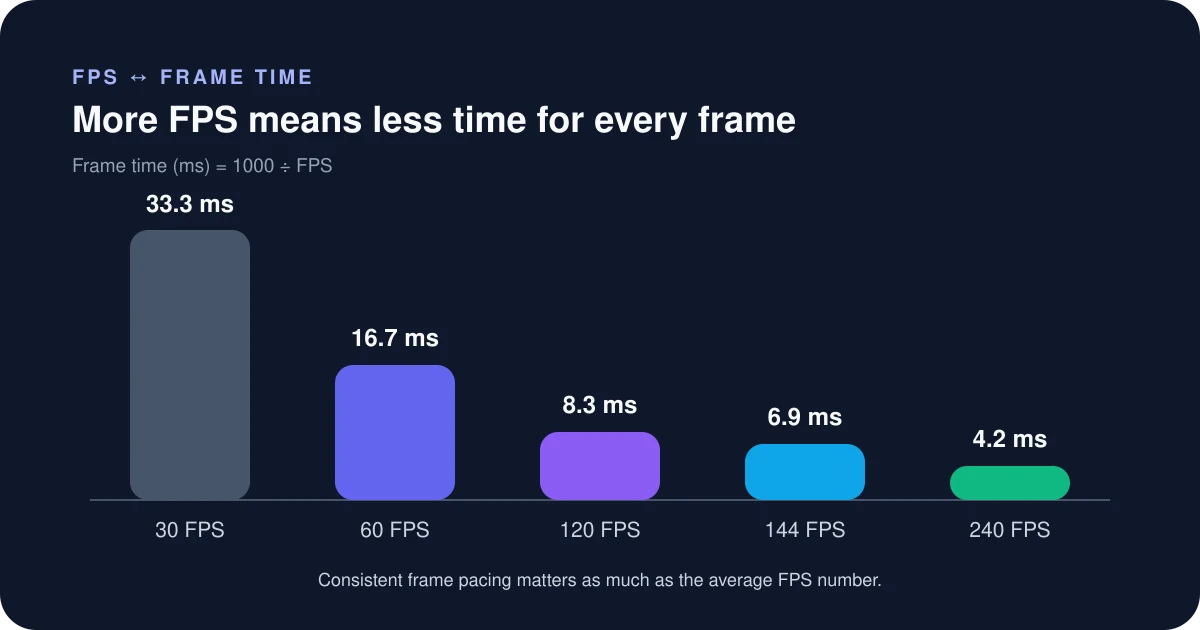
Frame time is 1000 divided by frame rate. Going from 60 to 120 FPS removes 8.33ms from every frame. Going from 120 FPS to infinity can only ever remove another 8.33ms. That single fact explains most arguments about high-refresh monitors.
The upgrade ladder
| Step | Frame time before | Frame time after | Milliseconds saved |
|---|---|---|---|
| 30 → 60 FPS | 33.33ms | 16.67ms | 16.67ms |
| 60 → 120 FPS | 16.67ms | 8.33ms | 8.33ms |
| 120 → 144 FPS | 8.33ms | 6.94ms | 1.39ms |
| 144 → 240 FPS | 6.94ms | 4.17ms | 2.78ms |
| 240 → 360 FPS | 4.17ms | 2.78ms | 1.39ms |
| 360 → 500 FPS | 2.78ms | 2.00ms | 0.78ms |
The first step is worth more than every step after it combined. The second is worth more than everything above it combined. From 144 FPS upward you are buying single milliseconds, and each one costs more than the last.
Why the curve is shaped that way
frame time (ms) = 1000 ÷ frames per second
Frame rate is a rate; frame time is a duration, and duration is what you perceive. Because the relationship is reciprocal, equal-sized steps in frame rate are not equal-sized steps in anything you can feel. This is also why frame rate is a poor unit for a performance complaint: “I lost 30 FPS” means something very different at 60 than at 300.
Consistency beats the average
An average of 120 FPS with occasional 40ms frames feels considerably worse than a locked 90 FPS. The eye notices the irregular long frame, not the mean, which is why 1% low figures are a better guide to how a game feels than the headline average. If your average is high and the game still feels rough, you are chasing frame-time spikes — shader compilation, asset streaming, a background process — and more GPU power will not fix them.
Matching a monitor
A display can only show what it can refresh. At 144Hz a new frame can appear every 6.94ms, so rendering 200 FPS cannot show you more frames — it only reduces how stale the newest one is when it is shown. That staleness reduction is real and is why competitive players still run uncapped, but it is a much smaller effect than the step from 60Hz to 144Hz.
- 60Hz display: a frame rate above about 70 buys you nothing visible. Spend on resolution or settings instead.
- 144Hz display: the sweet spot for most people. Target 144 stable rather than 200 average.
- 240Hz and above: worth it in competitive shooters at low settings, hard to justify elsewhere.
- Variable refresh (FreeSync / G-Sync): matters more than raw refresh, because it removes the tearing and stutter that uneven frame times cause.
Convert your own numbers
The FPS and frame-time calculator converts either direction and shows which refresh rates your frame rate can saturate.
Sources & verification
Frame-time figures are exact arithmetic. Perceptual claims are editorial judgement, not measured results, and vary between people and game genres. Last reviewed September 12, 2026.